Showing posts with label interview. Show all posts

Friday, September 23, 2011

My Chat With Jim Steranko on His Only Romance Comic Book Story - "My Heart Broke in Hollywood!"


While I was at the San Diego Comic-Con a couple months ago, I had the good fortune of meeting Jim Steranko. He was kind enough to divert his attention away from his convention duties and chat with me a bit about his only romance story, “My Heart Broke in Hollywood!” that was originally published in Our Love Story #5 (June 1970). Our meeting was happenstance, so naturally I was without a recording device. After we talked, I quickly ran off to scribble down some notes! So without further ado, the following narrative is what Steranko told me about his one and only romance story! The accompanying pages are the original color guide for the story!*


Initially, Steranko was asked to draw a Western story, but said that he wanted to do a romance story instead. He felt that so much of the romance comic book stories were done in the “Jay Scott Pike” style that he wanted to try something radically different, and unlike any other romance story anyone had ever seen!


After penciling and inking the Stan Lee plotted story, Steranko decided he would color it himself. Knowing his color choices were non-traditional for a romance story, he decided to wait to turn the pages in just before the 5pm deadline – by which time it would be too late to change anything! Steranko recollected that Marie Severin thought it was pretty wild, but ultimately let the story pass through as he intended.


Steranko went on to tell me that when Our Love Story #5 appeared on the newsstands, Carmine Infantino apparently called a meeting with his staff over at DC. As Infantino chomped on his trademark cigar, he passed out ten copies of the rival Marvel romance. He instructed his staff to open up to Steranko’s “My Heart Broke in Hollywood!” and exclaimed, “Top this next month or you're fired!”


And that, my friends is the story that Steranko told me! Unfortunately as I said, I didn’t have anything to record this discussion with since it occurred spur of the moment. But sometimes, those encounters are the best and elicit the most genuine of stories! It was clear from his enthusiasm that Steranko not only enjoyed telling me about his sole romance story, but that he had a great time creating it!


*A big thank you to color guide owner, Matthew Holtzman, as well as Tony Robertson who runs the terrific website, The Drawings of Steranko where the above pages are hosted. If you would like to read “My Heart Broke in Hollywood” it has been reprinted a few times and can be found on a number of websites including True Love Comics Tales which posted it just a few days ago!

Have a splendid weekend!!!

Thursday, August 11, 2011

Author Interview Series - How Experience Helps Write Your Book


Today I have the pleasure of interviewing Steffannie Roaché, author of Righteous Anger: Mad Enough to Make a Change.


A seasoned Christian Worker and Life Coach involved in lay ministries for more than 15 years, Steffannie is also currently working towards a Master’s degree in Counseling. Righteous Anger: Mad Enough to Make a Change is her first outpouring in a series of Christ-centered books created to address the modern needs of Christians and Seekers alike.


The topic of our interview today is how can we use our past and present experiences to compose a successful non-fiction book? Obviously, Steffannie has used her accumulated knowledge to compose such a book, but how did she decide to pursue this, how did she apply her experience, and what does the future hold for this new and inspiring author?


Carol Denbow: Greetings Steffannie, and thank you for taking the time out of your busy schedule to chat with us today. Can you please start by telling us a little about your new release Righteous Anger: Mad Enough to Make a Change?


Steffannie Roaché: Thank you Carol, I'm glad to share. This book focuses on a need for people to decidedly, purposefully, and with passionate intent, take back their freedom. It's specifically for Christians, but also other individuals that are seeking spiritual strength to overcome their worst obstacles. There are times we will place barriers in our own path, either by ignoring the empowerment of God’s own Spirit in our livers, or by lacking faith in our God given abilities. Righteous Anger: Mad Enough to Make a Change explores Biblical truths to tear down these barriers.


Carol Denbow: The book sounds wonderful. You have such a broad knowledge in your field. Does this come with education or simply mass experience?


Steffannie Roaché: Education and experience have both played a role in my work. I completed a bachelors in human development, and I'm currently working on a masters in counseling. My future plans are to finish my theological studies as well. Although these are important, its really about ministering to others. I believe many of us are drawn to help; whether it be in nursing, ministry and outreach, foster parenting, or volunteerism in some form. Our hearts seem to be compelled to reach out and help make a difference in the lives of others. Ultimately my work, education, and life's goals are a combination of these factors.


Carol Denbow: What made you decide it was time to share your experience in the form of a book?


Steffannie Roaché: The book was a natural consequence for me. After developing several Bible studies and working with people individually or in small groups, I realized a similar theme continually crept into our conversations. Even the most faithful Christians and good people struggled to overcome repeating patterns in their lives. It almost seemed as if they were systematically drawn back to issues that held them hostage. I found myself sharing the same Biblical truths and words of wisdom to encourage those searching for an answer, namely: How do I move from wanting change, to making a last change? This book is a culmination of these experiences and offers a humble answer to this question.


Carol Denbow: How long did it take you to complete your manuscript?


Steffannie Roaché: That's actually a difficult question to answer because I began writing Biblical studies and compiling notes on this topic many years ago. I had some portions in diaries and notebooks. When I finally purposed it in my heart to develop a complete manuscript it all came together in about 10months.


Carol Denbow: In the book, you are very passionate about your topic. Is there any past personal experience that may have driven you?


Steffannie Roaché: One event in particular did contribute to my work. Several years ago I had a personal experience with a time of depression and personal turmoil. I considered my self a faith filled believer and a strong person, so it seemed contradictory for me to have these issues. I couldn’t seem to shake it. Unfortunately I was too ashamed to seek professional counseling, not even help from my church. At that time, In the late 80's and early 90’s, there was a great stigma attached to 'needing help' for issues related to emotional or mental issues. Instead, I quietly hid my pain and began to search the Bible for answers. I also prayed and believed that God would help me to overcome the problems that faced me. Eventually I received victory in my life, and these experiences gave me a greater sensitivity for other Christians who know personal struggles.


Carol Denbow: Have you always been interested in writing, or is this book solely a goal to address the needs of your audience?


Steffannie Roaché: I have always enjoyed writing. It provides a form of expression as creative as a sculpture. Unlike other art forms, the message is delivered in tangible manner that can be clearly expressed to all who care to experience it. Although this particular work is non fiction, I have attempted to share some of my personality and creativity within the pages.


Carol Denbow: Where will you find your audience for this release?


Steffannie Roaché: My prayer is for Believers to use this book as one of their resources for personal and ministry related needs. I also hope individuals exploring spiritual truths will find many of the answers they seek in the pages. For these reasons I’ve written of an audience of Christian Believers and spiritual seekers in need of personal and spiritual growth.


Carol Denbow: Steffannie, you are amazing and inspirational to all of us. Can you please let us all know where we can see your Website and/or buy your new book?


Steffannie Roaché: My website is www.steffannieroache.com, the book can be purchased online through my website, Amazon.com, or at your local book sellers by request.


Carol Denbow: I hope this interview inspires some gifted writer out there to pursue an inspirational book they may have only previously dreamed of writing.


Steffannie, you are available and very open to online interviews should any of our blog visitors be looking for the perfect guest for their Website or Blog postings—correct? So where might they contact you to arrange this?


Steffannie Roaché: Yes, I welcome requests for online interviews. I also am available for appearances with large or small organizations. More information is available on my website as well. I can be contacted at www.steffsings.webs.com or by email at info@steffannieroache.com.


Carol Denbow: Thank you so much for doing this informative interview and we all wish you great success with your new book.

Again, the title is Righteous Mind: Mad Enough to Make a Change, 162 pages of inspirational and helpful information. ISBN 13: 978-1463560270. Thanks Steffannie, any final words? Future books planned?


Steffannie Roaché: One final thought I would like to share is that in the near future I will share an upcoming dating and relationship book specifically geared towards the single Christian person. I’m also excited to share that I am finishing a manuscript on multiculturalism in the modern church. Readers can stay informed about on the progress by becoming a website member at www.steffannieroache.com Thank you Carol for this experience. I really appreciated the opportunity to share with you and your readers.

Monday, April 18, 2011

Q & A with Michael Barson on "Agonizing Love: The Golden Era of Romance Comics"


Hi all! I hope your week is off to a great start! Today I have for you a short Q & A session I did with author Michael Barson about his soon-to-be released anthology of 1940s and '50s romance comics through Harper Design -- Agonizing Love: The Golden Era of Romance Comics. Grab your morning beverage of choice (coffee for me, please) and enjoy!


How and when did you become interested in romance comics?

I had been a comic book fan and collector since my teen years in the 1960s. But that was all about the superhero stuff -- I paid no attention whatsoever to the romance comics that were still being published then, though their heyday was already past. It wasn’t until much later, when I moved to New York City and was still collecting Golden Age comics, that I came across some early copies of the seminal Simon & Kirby titles Young Love and Young Romance – and I was hooked.


Why the time period of 1947-57, say over the later romance comics?


To me, the style of the stories and artwork seemed much more serious in that earlier time period. By the mid-60s, the content and art style has become simplified and, I think, also directed to a younger audience. For me, that didn’t work nearly as well. Of course, if I had grown up as a teenage girl in that same period, I might have liked them just fine. But I am a child of the Fifties.


Do you have any favorite romance comic book artists, writers, publishers, etc.?


I do favor the early Simon & Kirby material – those guys were flat-out geniuses! But as their titles became diluted as a product of the “S & K shop,” the standards were lowered to a way more average product. Matt Baker’s work for (primarily) St. John was always attractive and interesting. And I loved it when the Marvel/Atlas artists like Russ Heath and Bill Everett turned their talents to one of these Love stories… but that didn’t happen often enough! I also am a sucker for a good, trashy photo cover, many of which I have included in this book.


What publishers’ comics are featured in Agonizing Love?


There is a lot of material from a number of the pre-Marvel titles, a good amount culled from the Simon & Kirby titles Young Love and Young Romance, some from Harvey titles, some from St. John, from Quality -- probably a couple dozen publishers in all, if I stop to think about it. I didn’t do that much with Fawcett, Fox or DC, for various reasons.


Did you draw from your own collection for this book?


Yes, I drew largely from my own collection for this book, as I do for all of my pop culture books. But once I knew I had a publisher for this book, I did contact my dealer friends to augment my holdings with the best of what they had on hand at that point. You think you have seen it all, but you never really have. I even kept adding to my holdings after production on the book had closed. Such a shame!!


Do you have a favorite story included in the anthology?


If I had to pick, I’d probably opt for one of the several mother-in-law stories I included… maybe “Mother’s Boy” from Romantic Marriage #2 (1950). And yes, I have a mother-in-law. But I do also have a soft spot for the westerns that featured love stories—Real West Romances and the like. I guess I can identify with those (temporarily) untamed cowboys.


Thank you, Michael!

Michael Barson's Agonizing Love: The Golden Era of Romance Comics from Harper Design is set to release on May 10th and is currently available for pre-order on Amazon! Be sure to get your copy!

Thursday, January 20, 2011

Random Acts of Geekery Interview!

If you have a few extra minutes to spare today, be sure to check out the fine blog Random Acts of Geekery for an interview with yours truly! It was great fun being interviewed by Jon Knutson and I hope you will have an equally fun time reading it!

Thursday, November 25, 2010

10 Reasons Why I am Thankful for Romance Comic Books!

Now that the turkey has been eaten and the pie gobbled down, it is time to say thanks for romance comics! There are so many reasons why I love these gems from the 1960s and 1970s, but here are just ten reasons (in no particular order) I am thankful for the oft-dismissed genre!

♥ The Thrill of the Hunt
Whether found at conventions, comic book stores or on Ebay,
looking high and low for romance comics
is one of my favorite things to do!

House ads ♥
Advertising titles, stories and collections of books,
the house ads of the romance comics
are both informative and fun!

Stories from the People Who Were There ♥
I am so thankful that I have been able to conduct
interviews with the likes of Suzan Loeb, Irene Vartanoff and
José Luis García-López! I can only hope that many more are in store!

♥ Cardy Covers
Not much needs to be said on this point --
who isn't thankful for beautifully rendered Cardy covers?

Crazy Product Advertisements ♥
Fishing rods! Sea-Monkey necklaces! Diet aides! Wigs!
The list goes on and on of advertisements from the
romance comics to be thankful for!

Marc and Paul ♥
One is completely lovable and one is practically the Antichrist...
Twin advice columnists Marc and Paul couldn't be more
different, but that is why I love them so!

Serial Stories and Recurring Characters ♥
Becoming attached to a character in romance stories is
usually problematic due to their fleeting nature. Thankfully,
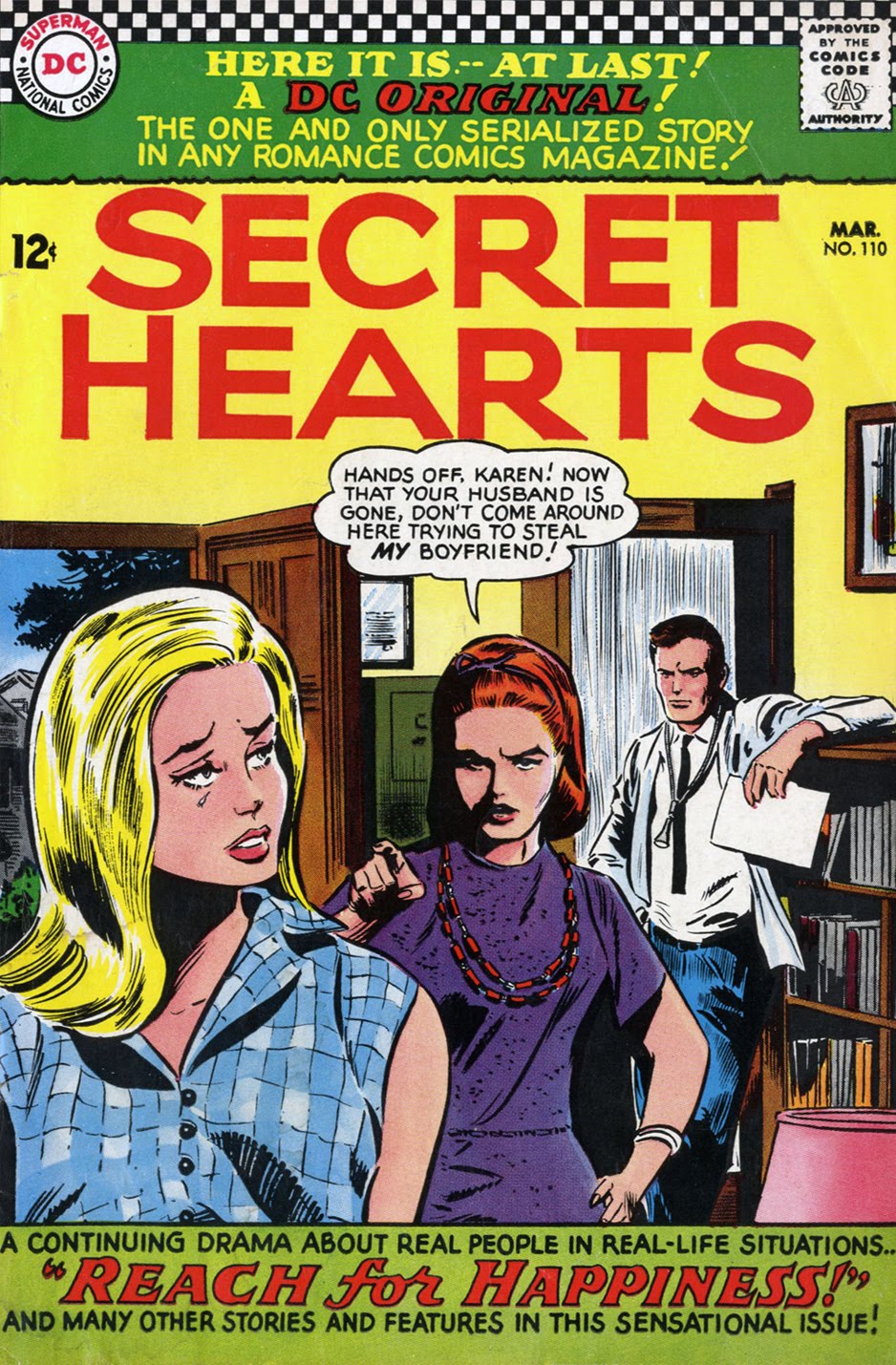
serials like "Reach for Happiness" and recurring characters like
Page Peterson, satisfy the need for continuity and familiarity.

Inspiring Fashion Spreads ♥
Romance comics from the '60s and '70s are so
captivating, in part, because of the incredible fashions worn by
glamorous characters! I know I sure am thankful for
Mad Mad Modes for Moderns and Dates 'n Mates!

♥ Easter Eggs
Finding an Easter Egg in a romance comic
(like this ode to Green Lantern) is always a treat!

♥ Readers of Sequential Crush
I have saved my number one reason for being thankful for romance comics for last. I will try not to be too gushy or cliche here, but honestly... I am truly thankful for all the amazing people I have met through a mutual love of romance comics. Readers, fellow bloggers, dealers and everyone else -- I am so thankful for you all! You have taught me things, inspired me and made my research of romance comics a continually enjoyable and worthwhile endeavor!!!

Happy Thanksgiving

Thursday, November 4, 2010

Interview with Charlton Romance Comic Book Artist, José Luis García-López!

I hope you all have had a wonderful week so far! As we head into the weekend, I am very excited to share with you a very special interview I conducted with the extraordinarily talented, José Luis García-López! Well known for his superhero work for DC, García-López drew romance comics for Charlton during the late '60s and early '70s!

The artist himself!
José Luis García-López


I began corresponding with Mr. García-López after he saw my post on "Seek Thy Love" from Love Diary #56 (October 1968) a few months back. I am so grateful we have been in touch because not only is he one of the nicest guys you would want to email with, he also is just an all around interesting man! He was kind enough to answer a few of my questions concerning his time drawing romance comic books for Charlton, so please -- enjoy!!!

♥♥♥

How did you get involved drawing romance comics for Charlton in the late ‘60s?

A friend who was an artist himself introduced me to an Argentinean agent taking art samples for Charlton. This was in Buenos Aires around 1965, and I was working in a small advertising company. Before that, I had just a handful of comics already published in short-lived comic companies (my first one I was 14 years old) but it was very hard to get paid and impossible to make a living. So, I guess my first really “professional” jobs were those done for Charlton after they saw my samples.


Did you draw the romance characters from models or other sources? What sorts of things inspired you when illustrating the romance comics?

Before the romance stories, my experience (or lack of it) was with western and war stories. So, when challenged to do romantic stuff I immediately looked at Juliet Jones by Stan Drake to learn how to do it. In those years we also had photo-novel magazines (like the foto-romanzo or fumetti in Italy) and they were very useful to design the characters and for the romantic scenes. Doing a good kiss without a good reference was very hard, honest. Besides, I was lucky to have two kindly girl friends that helped me with fashion advice and suggestions and even posed for me. That period was full of learning experiences – there is no better way to learn to draw than from a living model.

"Stubborn Heart!"
Career Girl Romances #71
(October 1972)

Did you ever look at the romance comics being published by DC or Marvel to see what they were up to?

I had no idea of anything done by DC or any other company, including Charlton. I didn’t even see my own work published. The only one was in 1974, a Jonnie Love story, I think. Thanks to you I’m seeing those (and getting ashamed of them) for the first time. What I remember looking at were English love stories published by Fleetway. Also, and very important for me, was an Argentinean artist working for Charlton and on British comics -- Ernesto Garcia Seijas. I looked closely at everything he was doing -- he was working with the same agent so I got to see his original art. I’m sure you found him already in some of the books you reviewed. His work was the best.

"Never Forget Me Jonnie L♥ve"
Teen-Age Love #93
(June 1973)


Concerning the process of creating the romance comics; did you write any stories or have any input on the plots?

Oh no, I was guilty of the art only. Besides, I didn’t speak English yet (technically, I still don’t).


How much freedom did you have to mold the stories based on your artistic vision?

Complete freedom. The only thing I got from the agent was suggestions about how to do a “typical American girl!” He told me for instance, Natalie Wood was a good example. It was funny though because Natalie was Russian or of Russian parents.


Did you always ink your own work on the romance comics?

Yes, we would never have imagined splitting art chores in Argentina in those days. That was something I discovered here. Nowadays I guess, many South American artists (and elsewhere) have adopted this system. Without doubt it’s good to keep deadlines and strongly embrace the publishing companies. Personally, even if I was lucky to have superb artists inking my stuff, I’d prefer to do it myself.


How much did you keep the audience of young women in mind when you were illustrating the romance comics?

I was aware to whom the stories were intended, but never lost sleep over it. My real problem then was to do it right and that meant a daily struggle with each drawing. Wrong anatomy is going to be noticed, whether the reader is a girl or a boy. Lucky for me, I had those two girls I told you about who criticized my work in an intelligent way, and from a girl’s point of view. So, I was kept in line.

"Discovery"
Hollywood Romances #52
(April 1970)

Were there any times when you felt that as a male you couldn’t convey these stories intended for a primarily female audience?

I never thought about it at the time. Now I'm more conscious (or more professional) when illustrating a story, but I don't think in terms of gender -- I mean a masculine or feminine audience, but in terms of age. I'm aware of the generational gap between my potential readers and myself, so I’m obliged to keep myself up to date.


Overall, did you enjoy illustrating the romance comics?

Yes, even with my lack of experience, I enjoyed every minute of it. It was an incredible learning experience I was going through. Even now, I consider romance stories the most difficult genre to illustrate properly.


Did you ever receive any feedback from the romance comic book fans?

Not that I was aware of -- remember I didn’t even have a chance to see them published. Anyway, my first fan was a girl :), but that because of a pirate character I did in the early '70s. It was for the Argentinean market but years later was reprinted in Europe.


Do you remember any stories or covers in particular that you liked or were especially happy with?

Well, I never did any of the covers. They used the first splash page from the story as such. And honestly, I don’t remember the stories. I suppose I was happy with the last three or four I did for them because I was more confident in my work.


Do you feel that the time you spent illustrating romance comics prepared you for the superhero work you began to illustrate in the 1970s? In what ways?

I think so. I can say that before the romance comics I was an amateur artist, and I graduated to a professional thanks to them. Besides, when visiting the DC offices for the first time, I discovered that Dick Giordano had been Charlton’s editor and knew my work -- it was like a presentation card for me.

"Seek Thy Love"
Love Diary #56
(October 1968)


What projects are you working on currently?

Mostly DC character art for licensing, but I take any chance to do comic books if I can get them with a flexible deadline.


Anything else you would like to share with the readers of Sequential Crush?

I believe in diversity and I would like to see more romantic comic books besides the well known superheroes. There’s a market out there for this genre (and many more) and Hollywood is aware of it. The Twilight Saga is a good example, isn’t it? Gothic Romance, but romance anyway.

♥♥♥

Fascinating stuff! I have to give a huge thank you to José for being such a willing participant and for his patience, as well as passion for the comic book medium! If you have enjoyed looking at and reading about the work of Mr. García-López, I would highly recommend joining the José Luis García-López fan group on Facebook!

Friday, March 26, 2010

Interview with Suzan Loeb AKA Suzan Says!

Hi there, romance comic book lovers! I am sorry I have been gone most of the week. I have been preparing for a conference that I am presenting at next week -- so I have been quite the busy little bee with that! However, as Women’s History Month draws to a close, I have something very VERY exciting that adds one more piece to the puzzle concerning the women that were working on romance comics during the 1960s and 1970s.

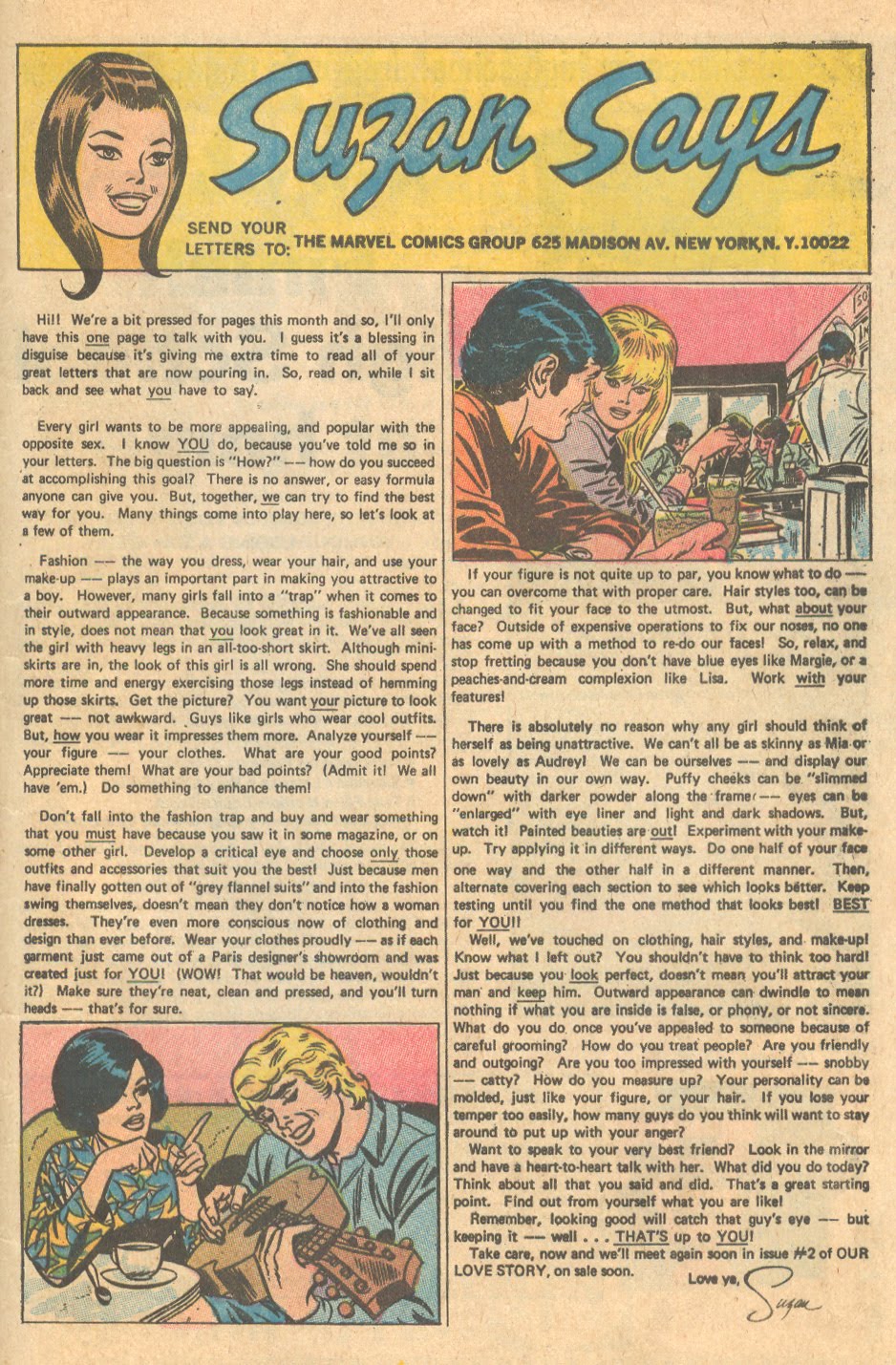
Fortuitously, Suzan Lane Loeb née Pasternack, the original writer on Marvel’s token advice column of the era -- “Suzan Says,” found Sequential Crush through her daughter and contacted me. I of course had about a billion questions for her! Suzan is the kindest woman you would ever want to meet, and graciously accepted my request for an email interview. Suzan penned the "Suzan Says" articles for issues #1 (September 1969) through #10 (March 1971) of My Love, and issues #1 (October 1969) through issue #10 (April 1971) of Our Love Story.


Put your snuggie on, settle in with a nice cup of tea and enjoy the interview!!!


****

Sequential Crush: How did you get your start working for Marvel?

Suzan: I graduated from State University College at Buffalo with a degree in English Secondary Education, but after a few years of teaching in the NYC School System, I realized I wanted to do something in journalism. One of my college suite-mates put me in touch with the Goodman Group. I interviewed and was sent to their Marvel Comics Group division, as a "Girl Friday." Isn’t it interesting to note how job titles have changed through the years...

----------

Sequential Crush: What was a typical work day like as a “Girl Friday” at Marvel?

Suzan Lane - Our Groovy Gal Friday
Bullpen Photos from Fantastic Four Annual #7 (November 1969)

Suzan: My tenure at Marvel was “BC”…before computers. Everything was done by hand. So, my duties in addition to manning the phones and fielding questions, were answering the mail, filling requests for back-copies of recent issues, reviewing gorgeous artistic samples from budding artists and hopeful young cartoonists, and passing on suggestions for story-lines. The offices were located on 59th and Lexington. My desk was in the front of the office area shared by Sol Brodsky and Roy Thomas, right across the hall from Stan Lee's office.

----------

Sequential Crush: How much interaction, if any, did you have with the artists drawing the romance comics?

Suzan: “The Bullpen” was inhabited by Marie Severin, Tony Mortellaro, Herb Trimpe, and John Romita, and wow, I got to see them every day. Their work was done in the office daily, and the other greats, including those directly involved with drawing the Romance Line, would stop by from time to time. I remember the laughter and camaraderie in The Bullpen...and was awed by the talent and watching a blank board come alive with blue pencil as the panels in the story took shape.
----------

Sequential Crush: How did you get involved in writing the advice column “Suzan Says”?

Suzan: Stan and Sol knew I was taking grad courses at Hunter and that I was a writer and English major. One day, I was called into Stan's office and he told me Marvel was going into the Romance business. He told me he wanted me to write a page to keep the continuity with the “Stan's Soapbox” concept. He even discussed the persona he thought he wanted me to assume...a divorcee with lots and lots of experience; but then ultimately decided on a young woman about my age.
----------

Sequential Crush: Who came up with the concept and the title of the column?

Suzan: It was Stan Lee himself who came up with the title, “Suzan Says”…as my first name is Suzan and I was going to be writing the column…and he liked the idea of an advice-to-the-lovelorn type, but he gave me free reign to write my pages; starting with three per issue, then sometimes only one or two.

----------

Sequential Crush: Is the picture based on your likeness?

Suzan: Sure is, but much, much more flattering. Can you imagine my incredulous delight when Stan asked Spider-Man’s Johnny Romita to pen my likeness for the banner for my column?!?!?!

----------

Sequential Crush: How old were you when you were writing “Suzan Says”? Do you feel that your age influenced the way you gave advice?

Suzan: I was in my mid-twenties when I began writing “Suzan Says”…a few years out of college and with two years of teaching experience behind me. I became engaged to my first husband while at Marvel. I don’t feel it was my age that influenced me. I believe what I brought to the job…who I was, my morals, values and ethics, and what I thought…most influenced me. When I was asked to write “Suzan Says”, the woman’s movement was just underway, and consciousness-raising groups were beginning and gaining in popularity. We were forced to connect with ourselves and be proud of being women who were in touch with our emotions.

Remember, this was the Pre-Computer Age... There was no Internet…no “Google”…no Facebook…nothing. The concept of sending letters provided readers with a format to pose real questions of concern and seek advice while also remaining anonymous…only first names were used in-print.
----------

Sequential Crush: Sometimes the letters sent in seem almost too unbelievable to be true! To what extent were the letters real in “Suzan Says”?

Suzan: The column encouraged write-in questions about personal issues and I was to select “universal” ones and answer with sound advice…from my “gut”. Remember, this was a “first” and the waters were virtually untested. When the initial wave of fan-letters came in, I was overwhelmed – by the volume and by the personal information shared in those letters.There had been no discussion with me, so there was no preconceived notion, as to who the audience of these romance comics was going to be. I just knew Marvel was interested in being part of a market that was out there and untapped…and that I was going to be a part of a new launch, and I was thrilled!

If you were thinking the audience was for pre-teen girls in those days, let me tell you the letters came from females and from males spanning all ages and all walks of life. The letters usually started with the person’s name and age, and were hand-written. Just by looking at the penmanship, if not stated, you could approximate the age of the writer. The tales that unfolded were real and very touching…men and women reaching out for answers that would resolve their loneliness and help gain them romance.I remember discussing this and expressing my concern regarding my qualifications to give advice that someone could take to heart and possibly use. The prevailing attitude was “it’s a comic book…keep that in perspective.” Yes, that remark came from a male staffer.

But, I was so moved personally by the issues presented and felt each person who took the time to write needed to know the letter was received and read by me. The volume made that impossible. A “form letter” response carrying my banner and signature was produced, basically thanking the reader for sending the letter; that the issue raised was of great importance and interest; but because of the volume of letters and time constraints, each letter could not be answered personally. The reader was encouraged to continue reading the comics and to look for an answer in either a story line or in a future column. Each letter received did get a copy of that letter.

----------

Sequential Crush: Did you prefer answering letters or writing the more straightforward advice based on a specific topic?

Suzan:
As for the letters themselves, some shared such pain and personal agony that I couldn't read them without getting involved. Because of my interest in reaching everyone who wrote, I thought about their questions “collectively”; then proposed a question based on points raised.

----------

Sequential Crush: Were you given a topic or did you come up with them on your own?

Suzan: I thought about my own experiences - nothing out of the ordinary - and realized that the romantic problems I faced were universal. I picked topics I felt I could answer appropriately and reach a vast audience. I guess the editors agreed with my decisions and choices because they printed what I wrote.
----------

Sequential Crush: To what extent did you draw from your own experience when giving advice? Where else did inspiration for writing the column come from?

Suzan: In addition to my own experiences, I drew on those of my friends…and believe it or not, on the themes of great romance novels. Remember, at the time, I was doing grad work at night at Hunter College studying English Literature.

----------

Sequential Crush: Did you have a good idea of who the audience you were writing for was demographically?

Suzan: I don’t think anyone realized how far-reaching this column was in its infancy. The newspapers’ version of advice columns were really geared toward answering “adult” problems…that was the demographic they played to. The romance comic reached a younger and more specific audience who could vent and speak directly to their personal issues without fear of judgment or reprisal.

Those letters...All ages, all walks of life, and from all over the country.

----------

Sequential Crush: You always signed “Suzan Says,” with a “Love ya!” Your voice was that of a concerned friend. Did you feel a connection to the audience you were writing for?

Suzan's first Our Love Story column
Issue #1 (October 1969)

Suzan: Absolutely! I felt a very strong connection to the audience I wrote for and I think those in charge of production thought so too, because even after I left, my columns were reprinted in subsequent issues.

Every one of us has, at one time in our life, needed a friend to turn to. Sometimes the problem we faced was too hard or embarrassing to discuss with a friend, and that’s where I stepped in. I could be that friend without judging you or jeopardizing our confidentiality.

----------

Sequential Crush: Having been a teacher, did you feel that writing the column was somewhat akin to teaching?

Suzan: No..I never made that connection or thought of that possibility until now with you asking that question. I felt that was I was doing was soooo very far from the teaching arena that I never drew the conclusion that I was teaching a lesson to make a point. My answers were straight from my heart; much the same discussions I was hoping I would have with my own “somewhere in the future” children.

----------

Sequential Crush: Did you ever have any input on the story lines for the sequential romance stories?

Suzan: No. I did attempt a few storyline suggestions, but none were deemed worthy of producing.
----------

Sequential Crush: Did you read any romance comics at the time, including the advice columns of the other companies to see what you were up against?

Suzan: Nope…I never looked at another comic product other than Marvel. I wanted to keep my own perspective and my own approach.

----------

Sequential Crush: Did you feel that the romance comics were authentic representations of the experiences of young women?

Suzan dishes out fashion advice in
My Love #2 (November 1969)

Suzan: In those days, yes I did. I really believed in the product and what it was saying. Most of the story lines were devised by men…remember the composition of the workplace and what women’s positions were in those days. I grew up with comic books and they were a very real part of all of our lives. They got people reading and learning about so very many things…romance included. Of course, most stories painted a most glorious happy-ending; and a few were heart-breaking. But, you know what…that’s a reflection of what real-life is all about. I think these comics did represent a myriad of experiences of young women, in a specific format. But the themes were very real.
----------

Sequential Crush: How did you feel about men writing romance stories – did you feel they were they legitimate authors of stories intended for young women?

Suzan: I think they did a fantastic job! I think they were the forerunners of the concept of men getting in-touch with their feminine side. They really understood what was going on, and were able to write from the woman’s point of view…without losing or compromising their own masculinity.

----------

Sequential Crush: Do you still stay in contact with anyone from your Marvel days or attend comic book conventions?

Suzan: No. Unfortunately when I moved out of NYC, I lost contact with everyone at Marvel. I have not yet had the opportunity to attend a comic book convention, but would really love to.

----------

Sequential Crush: Do any specific columns that you wrote stand out in your mind? Have you had a chance to go back and read any of your columns recently? Do you feel your advice has stood the test of time?

Suzan: Although each column has very specific meaning to me, I think the one that stands out the most, is the very first one when I introduced myself. I felt I had a lot riding on it because it was my first attempt to write something for Stan Lee. I was so happy when he accepted what I wrote without changing a word.

When you and I first connected I pulled out all of my issues and re-read them. Memories flooded back and I recalled, amazingly, what I was thinking and feeling at the time I wrote each of them. Funny, because sometimes now I can’t remember if I ate breakfast.

While the issues have changed and life and romance has become so much more complicated, I feel my advice was sound. Kept in the confines of the age in which it was written, it was appropriate for the time and yes, I do feel it still stands up.

----------

Sequential Crush: What are you up to these days?

Suzan: Using Marvel and my writing experience there as a “springboard” I developed a most interesting and satisfying career. I was an editor and writer for a now-defunct newspaper in the Bronx; spent many years on the West Coast; wrote descriptive plaques for museum pieces; worked and traveled nationally and internationally for non-profits – crafting speeches, brochures, newspaper articles, and the like; and now write the obituaries for a large city newspaper in the South. I did drive the Weddings Desk for a while…very interesting…
----------

Sequential Crush: Any other memories of your Marvel days that you would like to share with the readers of Sequential Crush?

Suzan: Other memories that stand out:

Had I stayed with the company longer than I did, Marie said she would help me learn to be a colorist.

When I was getting married, John told me “Don’t get fat!”…wish I had listened…

Once I was given a treat by one of the artists…He was drawing a series of stars in a panel and I got to draw one!

But, most importantly…Working at Marvel taught me something that stayed with me my entire career. If you can’t wake up in the morning looking forward to going to your job, then you’re in the wrong line of work! There was not one day at Marvel that there wasn’t joy and fun…getting the work done in an environment that applauded creativity and celebrated with joy, the individual.

Just look at all the people we reached…and through you, Jacque, and what you do…are still reaching!


Isn’t she great, ladies and gentleman? I don't know about you, but I feel inspired!!! How cool to have been a part of such a dynamic company during such an innovative time! Thank you so much, Suzan for sharing your memories with us. Knowing more about the contributors to the romance comics is such an exciting thing and really invaluable for fully understanding the medium! Have a great weekend everyone and in true "Suzan Says" fashion...

Love ya!

Tuesday, October 20, 2009

Interview with Irene Vartanoff!

Good evening! I promised last night in my post something special for tonight -- and here it is!!! I can't think of anything more special to share with the readers of Sequential Crush than this interview I conducted over email last week with writer and editor, Irene Vartanoff. You will probably recognize her name if you are a fan of Silver Age DC comics. She was one of the beloved letter writers featured in their letter columns during the 1960s! Even if you aren't familiar with her, take a second and read the fascinating tidbits she shared with me concerning her experiences in the comic book industry, her thoughts on romance comics and what she is up to today. I hope you enjoy reading this interview as much as I enjoyed conducting it!

****

Sequential Crush: From what I have researched, you got your start in the comic book industry by writing fan letters. How did you make the transition from writing fan letters in superhero titles to working professionally in the comic book industry, and working on romance comics in particular?

Irene: My generation of comic book fans had no comic book stores to go to, so we met each other through letter columns, fanzines, and conventions, which started quite small and thus were great breeding grounds for friendships. My first convention was in 1966, and I made lifelong friendships there. I also corresponded regularly with lots of comics fans, mostly male of course. Many of my comics friends were determined to break into the business, and they lived in the New York metro area. We kept in touch with each other and invited others into our circle. And we made connections with editors, whom we besieged with story ideas and samples while we were still in college. Some of us financed education through writing comics, such as my longtime friend, Mike Friedrich, who wrote Batman.

By the time I was out of college, I had already been a frequent visitor to DC Comics. It was not hard to convince them to give me a try, and in 1971 I worked simultaneously on superhero and romance stories. People at DC were extremely welcoming and I was insufficiently grateful at the time. I was very young, and arrogant enough to dare to go to the big city, but not quite ready for it on several levels. I did not ride out my moments of self-doubt to writing success in comics. I was a sheltered girl from the suburbs who was trying to make it in a strange place as a freelancer, without much support system or money. After a while, I had to take a break and go back home.

----------

Sequential Crush: According to your website, you have worked for both DC and Marvel. Can you elaborate on your time spent with both companies?

Irene: My second try at living in NYC started with a full time job offer from Marvel in 1974 to be Roy Thomas’ assistant. I of course already knew Roy, but the opportunity came via my friend Marv Wolfman, who had married a good friend of mine, Michele Kreps, who was a high school friend of my sister Ellen’s. I had been the female witness at their Long Island wedding; Mark Hanerfeld, a dear, now departed friend, was the male witness. I had kept up with the business even while I was in graduate school. And I made frequent trips to the NYC area, visited the comic book companies, and went to conventions. The job offered stability, so I didn’t have to worry where the rent money was coming from each month. By then I had several sources of social-emotional support, good friends living in the area, and so I took it. I stayed at Marvel for over six years.

I started with various editorial assistant tasks and then moved to being the reprint editor (an assistant editor role) and then into managing reprint production. Then came special projects coordination. I spent most of my career at Marvel in production, supervising a handful of employees and freelancers and teaming with people from other companies to produce joint projects. I did hardcover and paperback books, newspaper inserts, posters, Star Wars reprints, newspaper strips, and more. I also did the infamous cleanup and inventory of the Marvel art warehouse.

I left Marvel in 1980 and went to DC to work for Paul Levitz, whom I had known since he was a young fan. I worked strictly in the business end, doing rights and permissions, writing contracts, and getting involved in licensing opportunities and business development. It was fun, but by then I was eager to work in the romance novel business. So I left in 1982 to freelance for Silhouette Books, and then Berkley and Bantam. I have never been sorry.

----------

Sequential Crush: Romance comic advice columns such as, “Marc – on the Man’s Side” were written from a character’s perspective. Were you instructed to write from the character of Suzan, developing her as a personality, or were you given free rein to answer how you wanted – is Suzan you?


Irene: By the time I was writing Suzan Says, those Marvel comics were strictly reprint. We did it as a trial balloon to see if anybody even cared, and I had editorial input from the other women in the office, especially Michele Wolfman. So the answers were probably a consensus. (After all, what did I know about pre-teenage dating? Nothing.) We got into trouble with management once when somebody sent a joke letter asking if she should have sex with her boyfriend, and we told her to get some birth control. That letter and its answer did not see print. Adults have loosened up in our society considerably since then.

----------

Sequential Crush: Sometimes the letters in the romance columns seem too unbelievable to be true! To what extent were the letters real in the romance columns? Where they primarily answered by men or women?

Irene: All I can talk about is what I did. The letters I answered were 100% real. The Marvel romance comic lettercols were reprints until I started writing them, so those letters could have been fake originally and likely would have been answered by men. But there were always a few women around at Marvel, and it may have been that the lettercols were thrown to them to do. You might ask Flo Steinberg. Anyway, I convinced Marvel to do a new romance letter column instead of the reprints; somewhere, I probably have the memo I wrote pleading the case. But I was wrong to think that it would spark more interest in the comics. The audience seemed to be 12-year-old girls, and not many of them. The romance comics were a moribund product.

----------

Sequential Crush: How much interaction, if any, did you have with the artists drawing the romance comics?

Irene: At the time I was writing romance comics for DC Comics (1971), I saw plenty of artists around the offices, but I didn’t deal with them directly. I knew who they were from being a fan. But DC artists worked from full scripts, and all contact was with the editors.

----------

Sequential Crush: In the comments you left on Sequential Crush regarding the Marvel story on the Women’s Movement, you cite the death of the romance comics as stemming from women not being able to relate to the stories – what direction should the romance comics have taken to ensure their survival, or do you think their decline was inevitable?

Irene: At the time, young women were as divided about what their lives should be as young men were, although we at least did not have to worry about being drafted. Some young women were living sexually liberated lives, and others were not. Some were intent on starting careers, and others were hoping to work only long enough to find someone to marry. And many were sticking a toe into both camps. As I said before, it was a confusing time.

DC Comics made a heroic effort to produce modern, relevant romance comics. But they never dared cross the line into the sexual revolution (or even the social revolution) that was the key to reaching the mass of women. All the comic book heroines were still crying over men and living soap opera lives and hanging out at the country club. There were a lot of underwear shots, too--and not of the men, darn it! Visually, the DC romance comics far surpassed most of what Marvel had to offer, not because they were better drawn (you could hardly improve on Johnny Romita), but because DC dared to use foreign artists and go for a genuinely modern vibe. Thematically, they both had issues.

At the time, a lot of young women were wondering how on earth they could manage to have careers and not alienate boyfriends or their families, and what, if anything, they should give up for love (including virginity), and more. These themes either were not addressed in romance comics, or they were given classic solutions: just quit your job, honey, and let the man decide it all; learn to love the status quo, etc. There was zero discussion of premarital sex; it did not exist in romance comics. We knew that was baloney. Not only were these comics out of touch with our reality, but they were propaganda for a prior reality. Yes, men have always pressured women for sex, but the pressure was far more intense on young women in a more sexually free society than it had ever been, because the negative consequences were lessening. The comics ignored this changed dynamic. He-men who were willing to take care of us the old-fashioned way were in noticeably short supply in real life (they were mostly in Viet Nam, getting killed or messed up), even if we wanted them. And some of us did not. So romance comics more and more seemed irrelevant to the mainstream of American young women, the same young women who might have read romance comics as girls a few years before.

My personal opinion is that the explicit sex that opened out the heroine-hero relationship in romance novels in the 1970s was the key element responsible for their boom. Why sex? Because it was an easier sell than social justice. Women had been raised to sacrifice, not to develop as people or reach out for what they wanted. Even women who knew what they wanted weren’t always ready to admit it to themselves and align with feminist goals. (Heck, they weren’t ready to admit they wanted orgasms, either.) Romance novels, though, did address those issues as well. But the come-on was sex. This could not be replicated by romance comics. If they had switched to a core of social issues themes, they might have alienated their still-confused audience, and if they had switched to more relevant sexual issues, the comics companies risked banning or arrests for producing immoral stories and pornography—because comics were considered a children’s product. Romance novels, meant for adults, could open the bedroom doors, and they did.

So the romance comics remained soap operas, which seemed safe enough but ultimately was a dead end. The problem with the soap was that in the early 1970s, confessions magazines (prose soap opera) were extremely sexually explicit themselves. Not safe at all. Romance comics dared not up the ante to match the confessions. Thus romance comics offered no truth and few thrills as compared with their direct competitors, the confessions, or with romance novels, or with the explicit movies of the day.


A strong line of female-oriented Gothic romances might have worked a few years earlier to transition the romance comic audience, but the Gothic comics eventually produced were mostly male-oriented weird mystery tales. And they were all started too late, after the subgenre had peaked, and after the romance comic audience had wandered away. I’ve covered this in detail in the blog at MyRomanceStory.com, “Why Gothic Romance Comics Stumbled.” Basically, the Gothic trend peaked around 1965, and comics finally noticed Gothics only years later. This would be like doing vampire love stories à la Twilight (but from a male point of view) five years from now. Too late. Also, when DC Comics did romance comics in the old days, and into the 1970s, they had female editors. Coming out with Gothic comics with male editors and male writers, years after the bloom was off the genre, compounded the error.

The decline of romance comics was not inevitable, but it would have taken a visionary with nerves of steel to turn them in a profitable direction. Our whole society was in flux; no one knew what would happen next. It’s not surprising that no one could steer romance comics to a new day.

----------

Sequential Crush: How did you feel about men writing romance stories–were they legitimate authors of stories for young women?

Irene: A truly excellent writer ought to be able to write from the perspective of either gender, any age, and any personality, race, national origin, or whatever. And most men do not live alone; they live with women. The men writing romance comics in the 1960s, for instance, were mostly married men living in the suburbs. They could always check out point of view with their wives, or observe their daughters. But always, they would be filtering it through their own perspective. So that’s one strike against men writing romances for women.

The second strike is that most writers are not excellent, and therefore are not flexible enough to write beyond their instinctive biases. So in general I don’t think much of men writing women’s fantasies, or women writing men’s. I have no longing to see how various currently famous male comic book writers would write new romance comics for women. I’m interested in the authentic female experience. I think it is part of feminism that we should not have our fantasies dictated to us or even related to us by men. It is important for women to learn what their fantasies are, rather than be told what they should be, or worse, what they should accept as a happy ending.

----------

Sequential Crush: What is your opinion when it comes to romance comics being relegated to the sidelines, and considered less “important” or “respectable” than superhero comics of the same period?

Irene: Everything women do or like is considered less important than what men do or like. To me a telling example of male literary bias is the way P.G. Wodehouse’s perfectly pleasant comedic novels were elevated to the status of literature with a capital L when they’re just entertainments. And were written as such. But they are entertainments for men, and thus, have stature. Oh, boo hoo.

Truth is, I can’t get riled up about this anymore. It still bothers romance writers, I know, even though they earn far more money than most writers in other genres because romances are so popular and widely reprinted throughout the world. But when simply reading comics of any kind meant that you were reading tainted literature that could rot your morals—according to Wertham—the fact that romance comics were mostly ignored was hardly important to me. At least they were beautifully drawn, and much of the allure of comics for me was visual.

As a business decision, ignoring more than 50% of your potential customers (that would be females) might seem stupid. But if you have no clue how to attract those customers, it’s smart. It costs less to launch a comic and aim it at 25 year-old men if you know that market well because you are a 25-year-old man or think and act like one. If you try to please both men and women in a shallow, careless, or know-it-all manner, then you end up with rom-com movies that please no one. Very bad ones, or is that understood?

On the other hand, if sales of your male-oriented products are tanking, then maybe you should reach out to the female audience. Japanese and Korean manga publishers don’t seem to have any problem selling plenty of imports to American girls and women, just as, years ago, Harlequin sold British Commonwealth imports to Americans. But American comics publishers today haven’t figured it out. The stories must have the genuine American female romantic sensibility, and even women working in American comics today often do not have it. After all, you don’t usually succeed in a male-oriented business by espousing a female point of view. This country is long overdue for genuine women’s comics, but they are not likely to be produced by current comic book insiders.

----------

Sequential Crush: You now blog about romance novels. Do you see an intersection between the romance comics of the 1960s and ’70s and romance novels?

Irene: There’s too much to say about their similarities and differences. I’ve covered some of it in the blog in the past. Generally, the romance comics of the 1960s and what few were produced in the 1970s did not parallel romance novels; they paralleled soap operas. Sure, there were the standard secretary-in-love-with-her boss stories that also appeared in romance novels, but novels usually had some kind of suspense element as the main plot driver. In fact, most American-written contemporary romances in the 1960s had romantic suspense plots. Only Harlequin was content to let the entirety of their plots revolve around the romantic relationship; but those were not stories by or about American women. By contrast, Gothic novels often were American in origin (the late great Phyllis A. Whitney being a major example of an American Gothic romance writer) and had strong themes about trust and about how men were not supporting (emotionally or intellectually) the women they claimed to love. I’m pretty sure I’ve done a blog essay on how the heroes would keep dismissing the heroine as hallucinating the many attempts to kill her, for instance. One of the graphic novellas I wrote for MyRomanceStory.com (as Nazalie Austin), “The Beaufort Ghost,” is a straight Gothic; the hero does not believe that bad things are happening to the heroine, which causes her to have a crisis of faith in him. He’s quite the selfish so-and-so. Romantic suspense novels generally hinged on the same question: could the heroine trust this man with her life? The men usually turned out to be undercover FBI agents.

Romance comics at the time were not like that. During a period when romantic suspense (the genre to which Gothics belong) reigned supreme, there was none in romance comics. They seemed to be stuck in dating games; the heroines mostly lived at home and did not do anything but socialize and yearn. There of course were some classic wish-fulfillment tales like the aforementioned secretary in love with her boss who feels inferior to the glossy society girl he dates. It was sheer soap opera stuff. It’s true that the glamorous “other woman” did show up routinely both in romance comics and in romance novels until the 1980s. There is always a place for a bitch character in a world in which women compete against each other for men. But that dynamic no longer exists in contemporary romance novels, because women now see that they have other options in life besides marrying a man with a steady income.

----------

Sequential Crush: What other projects are you currently working on?

Irene: I use blogs to explore many topics that interest me, at essay length. The romance blog is part of the MyRomanceStory.com site, so technically it’s not mine. The personal finance blog, Lose Your Money Blues, is strictly mine. And, yes, on it I talk personal finance and simplifying your life, and more. When I’m not blogging, I’m writing novels, as yet unpublished. So far I’ve got one that’s a light superhero fantasy novel melded with a gentle roman à clef plot about the comic book business, and two novels that are what are called women’s fiction—about several women of different ages with various intertwined issues to resolve. And I’m still in the midst of writing a historical novel (not a romance) about a girl observer at Henry VIII’s court during the rise of Anne Boleyn. I’m also working on a sexy time-travel romance involving the Tudor century. And soon I’ll be starting something new, probably romantic suspense, as it happens. I’ve set an ambitious writing schedule for myself for the immediate future, and it is very gratifying to see that I am managing to stick to it.

I’d love to write more romance comics, but no one seems to be doing anything new in that arena lately. If I could draw, I would publish web romance comics myself. I adore comics and always will. I am at peace with the lack of a major supply of American comics for women, although I do wish it was otherwise. But I worry that the age of illustrators has passed, and with it, the top-notch artists who could draw glossy, sexy women and men, plus fashionable, attractive clothing and settings, thus, suitable objects for romantic fantasy. I look at my old Lois Lane comics done by the wonderful Kurt Schaffenberger and wish there was anyone today who could come close to matching him. Or anyone who even cared to. Leonard Starr and a few others are still alive and working. But where are the romance comic stories for them to draw?

****

A huge thank you to Irene for answering all of my questions in such depth, and with such enthusiasm and vigor! I don't know about you, but her words have definitely given me a lot to think about and certainly add to my knowledge of the industry! Be sure to check out Irene's website to stay up to date on her current projects!